A Night Out | The Frick Collection’s Autumn Dinner Celebrates Annabelle Selldorf in a Grand Homecoming

On Tuesday, October 20, The Frick Collection welcomed guests back to its historic Fifth Avenue mansion for the 2026 Autumn Dinner, an elegant black-tie affair honoring architect Annabelle Selldorf.

The evening marked the first Autumn Dinner held inside the museum's Gilded Age residence since the completion of its ambitious renovation in 2025, making this year's celebration particularly meaningful.
The annual gala raised an impressive $2.8 million in support of the museum and Frick Art Research Library, helping fund everything from conservation and educational programming to future exhibitions.
But beyond the fundraising milestone, this was a celebration of something New Yorkers hold dear: the preservation of a beloved cultural landmark and its thoughtful evolution for generations to come.
An Extraordinary Setting for Dinner

There are beautiful dining rooms throughout New York City, but very few offer the opportunity to enjoy an evening surrounded by masterpieces from Vermeer, Rembrandt, and Turner.
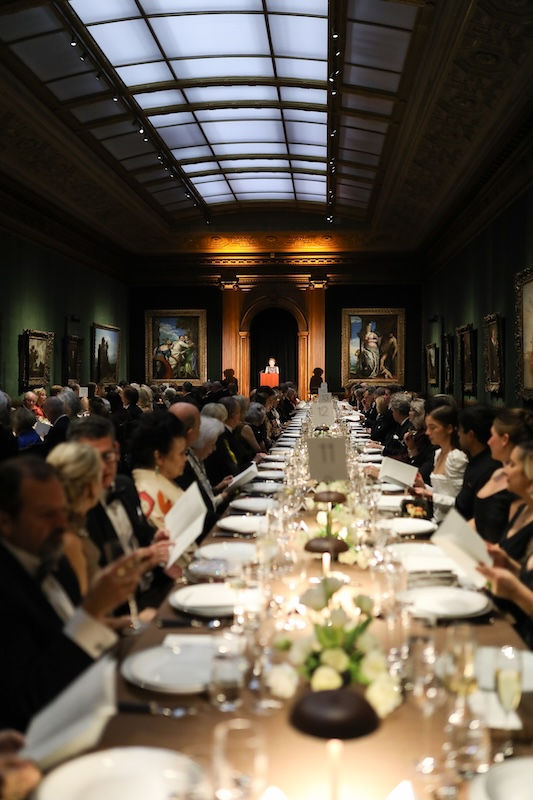
Following a cocktail reception, guests made their way into a series of first-floor galleries, where the museum's extraordinary collection served as the backdrop for an intimate seated dinner.
The setting itself needed little embellishment. Rather than compete with the artwork or the mansion's architectural character, the evening's design embraced a more restrained aesthetic that felt entirely appropriate for the occasion.

Elegant brown table linens were paired with white and silver place settings and low floral arrangements, creating a modern, understated look that complemented the historic interiors.
The decor, designed by Marfala, subtly echoed Selldorf's architectural philosophy, where contemporary elements are introduced with a sensitivity to the spaces around them.
Olivier Cheng Catering & Events oversaw the evening's hospitality, adding to the sense of occasion without distracting from the museum's remarkable surroundings.
What made the setting especially memorable was the relationship between the art and the guests. Rather than viewing the galleries as visitors passing through, attendees were invited to spend an evening within them, experiencing the collection in an entirely different way.
Celebrating the Woman Behind the Frick's Transformation
At the center of the evening was Annabelle Selldorf, founder and principal of Selldorf Architects, whose vision helped guide the Frick through its most comprehensive renovation in ninety years.
For an institution so closely associated with its original Gilded Age character, the undertaking required a particularly delicate balance.

How do you modernize one of New York's most treasured museums without losing the qualities that have made it so special?
For Selldorf, the answer was not to overshadow the past but to create a more welcoming, accessible experience while respecting the building's history.
Elizabeth M. Eveillard, Chair of the Frick's Board of Trustees, opened the dinner by recognizing the scale and sensitivity of the project, noting that "there was no one better for the task" than Selldorf.

Before dessert, Axel Rüger, the museum's Anna-Maria and Stephen Kellen Director, reflected on the renovation's accomplishments, including its LEED Silver certification and a remarkable year of attendance and engagement following the museum's reopening.
He also highlighted Selldorf's next major undertaking: helping reimagine the Musée du Louvre in Paris, including a new museum entrance and a dedicated gallery for the Mona Lisa.
Architecture That Makes People Feel Welcome

One of the evening's most thoughtful moments came when Selldorf accepted her honors, presented with a commemorative silver tray.
She acknowledged the many people who helped bring the Frick's renovation to life, including her own team at Selldorf Architects and executive architects Beyer Blinder Belle.
A project of such ambition, she remarked, requires not simply a village but an entire city.
Her remarks also offered a refreshing perspective on what successful architecture can accomplish.
Speaking about the importance of creating a sense of welcome, Selldorf suggested that thoughtfully designed spaces can encourage people to see themselves and the world around them differently, perhaps even with greater empathy.

It was a particularly relevant sentiment for an institution like the Frick, where architecture and art have always been inseparable.
While Selldorf is internationally recognized for her work with museums, galleries, and cultural institutions, the Frick project feels especially personal to New York. It represents the challenge of introducing new ideas into a space that already holds considerable meaning for so many people.
A New Chapter for a New York Institution
Originally the residence of industrialist Henry Clay Frick, the museum has welcomed the public since 1935 and remains one of the city's most distinctive cultural destinations.
Unlike larger museums, where visitors can spend hours moving through seemingly endless galleries, the Frick has always offered something more intimate.
Its paintings, sculptures, furnishings, and decorative arts exist within the context of a historic home, creating an experience that feels as much about place as it does about the collection itself.
That distinction made this year's Autumn Dinner all the more significant.
Returning the annual celebration to the mansion following its multiyear transformation was an opportunity to recognize both the institution's legacy and the people helping shape its future.
The evening was led by gala co-chairs Margot and Jerry Bogert, Elizabeth M. and Jean-Marie R. Eveillard, Jane and Michael Horvitz, and Christine and Stephen A. Schwarzman, with the support of an esteemed group of vice-chairs and Young Fellow gala co-chairs.
An Evening Worth Remembering

New York's fall social calendar is filled with impressive galas, but the Frick Collection's Autumn Dinner offered something that cannot easily be recreated elsewhere.
The opportunity to gather for dinner among extraordinary works of art, inside one of Manhattan's last great Gilded Age homes, is remarkable in itself.
Yet what made this year's celebration particularly compelling was its larger message about preservation, creativity, and the importance of making cultural spaces feel relevant and welcoming.
With $2.8 million raised and a newly renovated home to celebrate, the 2026 Autumn Dinner was both a tribute to Annabelle Selldorf's vision and a meaningful milestone for the Frick.